Digitized School - Let's Speak Plainly
 Micke Kring
·
Micke Kring
·
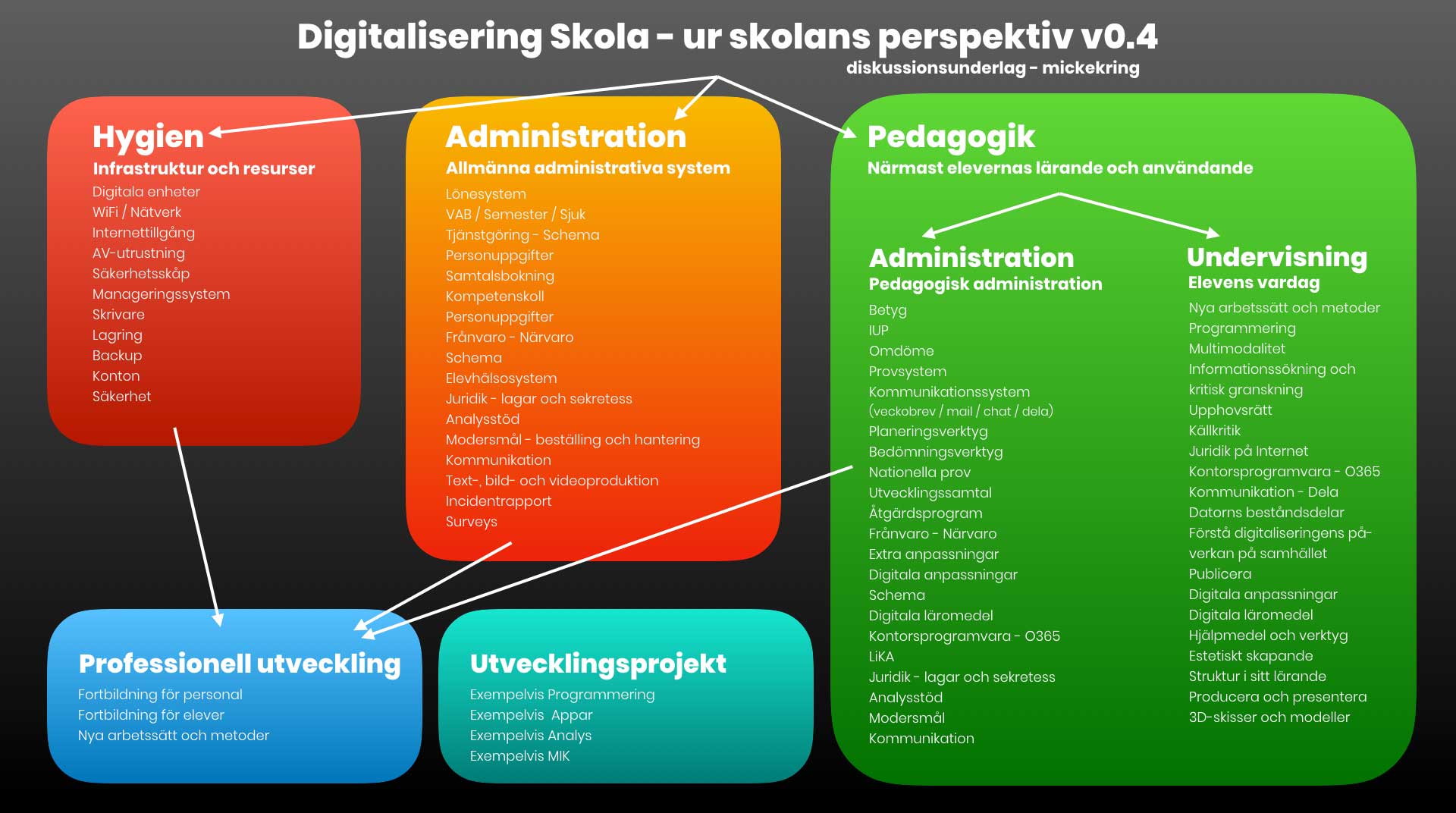
In the post “Digitaliserad skola – Först måste vi prata dålig IT i klassrummet” I wrote about one of four parts of the school’s digitalization that I call Hygiene, that is Infrastructure and Resources. Here I thought I’d briefly present the four parts with a visual aid.
The image is intended to be used as a discussion aid when we talk about the school’s digitalization, to make sure we’re on the same page, mean the same things and understand the purpose. In other words, it’s not comprehensive, but gives an indication of how I view the different parts of digitalization. How many times have you seen similar statements like:
“All you have to do is take advantage of — and streamline operations through digitalization!”
Of course nothing is said about how, or which parts should be digitalized, or what effects are expected in the different areas. With this image we can point to — and ask the person (and ourselves) which part they mean and how they intend to change it with the help of digitalization.

The four parts are, in my view, Hygiene, Administration, Pedagogy (which includes two subcategories, Pedagogical administration and Teaching) and Professional development. I will not write more about these in this post, but take a look at the image — and download and use it as you like (CC 0) if you want — and ask yourselves a few questions:
- Which part(s) do you think are most relevant to the various professional groups working in schools, from those at the top in politics to those working on the school floor?
- What competence do you think is needed to judge whether systems in the different parts are good — and who already has it? Are these the people currently responsible for “procurement”?
- All parts involve some form of professional development (training). Everything you do takes time. When you introduce something new, is there always an estimate of how much time will be saved in the long run, or a demonstration of what will improve?
- Are all these systems necessary and why do we have them?
- Regarding administration (both parts) — do we use the data we collect in a way that justifies collecting it?
- Regarding resources (money and training) — where does the largest pot end up? Shouldn’t it be in the teaching part? Or does it?
If you have more questions or comments, don’t hesitate to get in touch!

About the author
Micke Kring
I'm fascinated by what happens when people and technology meet. After nearly 30 years in education and development, I explore, prototype and teach AI with the same playful curiosity as when I first started out.