Designing for Learning - We're Releasing the Report Now
 Micke Kring
·
Micke Kring
·

During the autumn, my colleagues and I worked on designing and building an internal MIK course. We wanted both to look at how different forms of learning support affect outcomes, such as reflecting with the help of AI. But also to explore how question-based learning works.
The report can be downloaded at the bottom of the article.
The report was written by Kristina Söderberg, together with me, Katarina Pietrzak, and Johan Salomonsson.
However, we had additional colleagues involved in the project as content experts in the area of MIK.
MIK stands for Media and Information Literacy and is a subject that is becoming increasingly difficult to navigate in light of generative AI.
In short, we found that question-based design works, although it doesn’t appeal to everyone.
Reflection on one’s own learning likely contributes to deeper learning.
Having access to an AI study buddy is perceived to increase engagement and contributes to a higher completion rate.
Prototype - eLearning platform
Since our procured e-learning platform couldn’t be used the way we wanted, I built my own. It was the first larger AI-coded prototype I’d built.
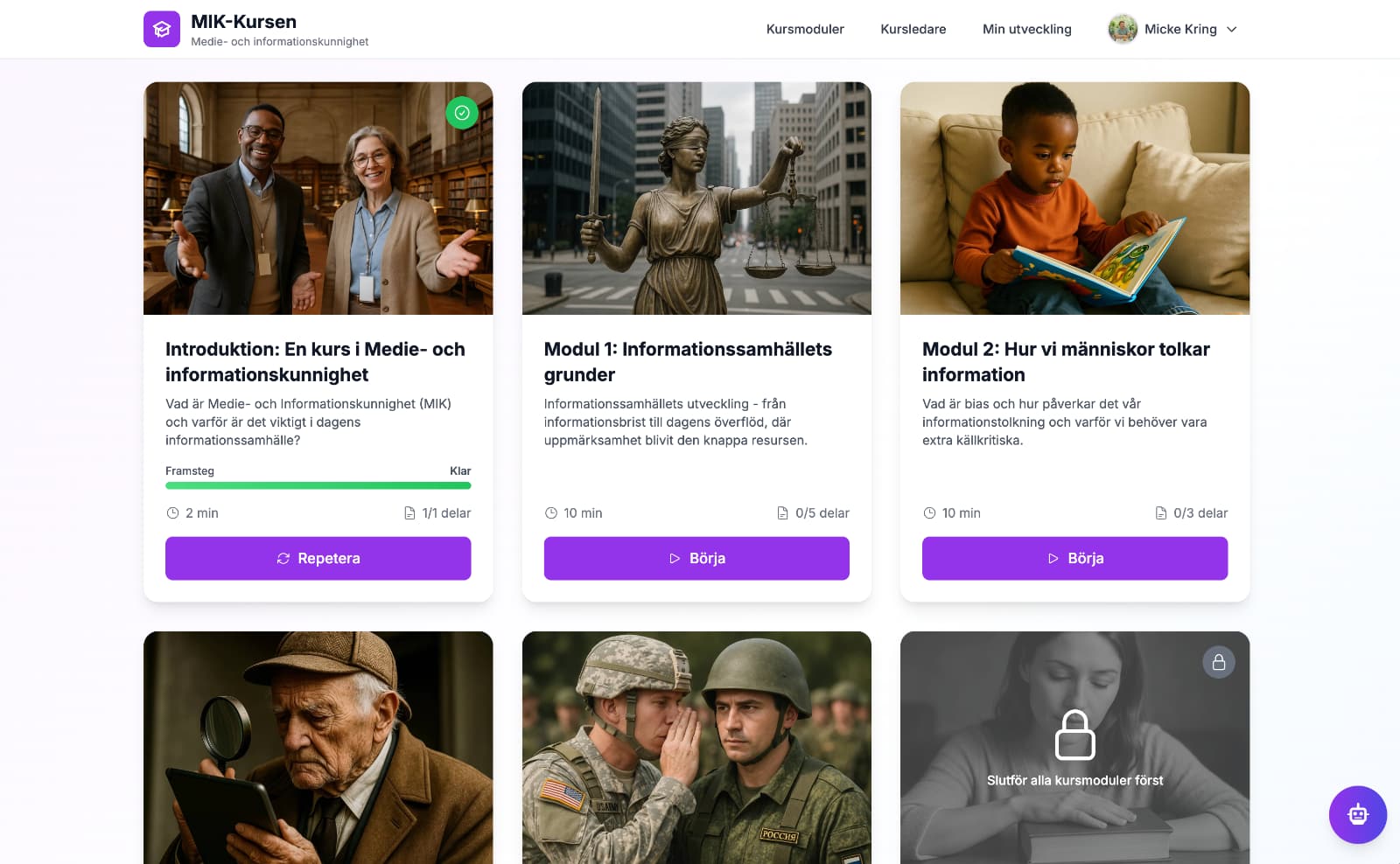
For the test group that had access to the AI assistant, they could access it throughout the course. The assistant knew where it was in the course, which allowed it to answer questions about the current section.
In hindsight I would probably have done some things differently, but it’s easy to be wise after the fact.
The language model used was GPT-4.1.
Abstract
This report presents results and lessons learned from the implementation of a digital course on media and information literacy, with a particular focus on how different forms of learning support affect engagement, completion, and knowledge development. The course was designed with a question-based learning design where participants first took a stance on questions and statements, and then accessed course content as needed. The study compares three variants of the course: course material only, course material with reflection exercises, and course material with an AI mentor. The results show that the course was perceived as relevant and that the majority increased their knowledge, but that different forms of support affect the learning process in different ways.
Download the report
https://www.diva-portal.org/smash/record.jsf?pid=diva2%3A2031082&dswid=-1763

About the author
Micke Kring
I'm fascinated by what happens when people and technology meet. After nearly 30 years in education and development, I explore, prototype and teach AI with the same playful curiosity as when I first started out.